


I have heard stories about Parisians impatient with people who speak only one language, but I have witnessed, instead, a willingness to help on nearly each occasion my words have failed me (and this is often). Looking for the laundromat was especially daunting as I cannot keep left and right in my brain, but a man at a Chinese restaurant and a woman at a vegetable stand pointed me in the correct direction (right across from my hotel; I was several blocks away at the time). Most Parisians do not offer directions with street names (in fact they do not seem to recall them), but they know that after two rights, the laundry will be on the left hand side in the middle of the block.
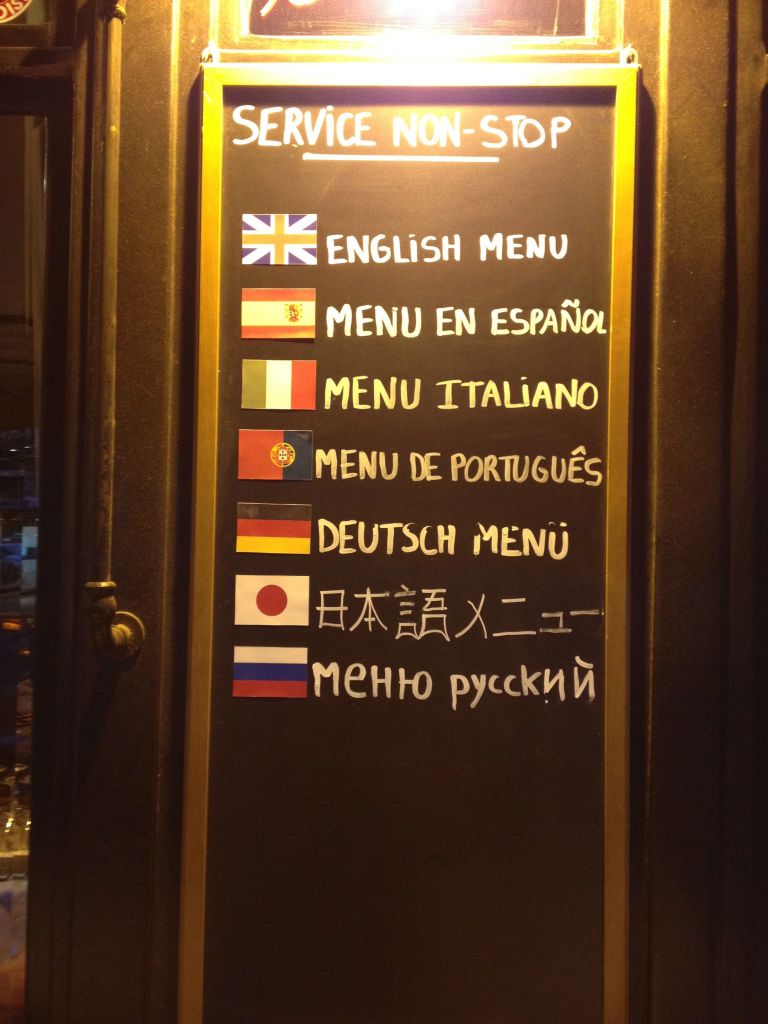
At dinner time, we vacillate over using the translated menu. I know the words for some of the things I do not like to eat. Even more, I enjoy the surprise of finding new dishes I might never have been introduced to had I known the words in the first place. Many restaurants not only have menus translated in English. They have multiple other languages to accommodate visitors.
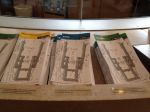
The Louvre offers a plethora of maps in languages including: Arabic, Chinese, Deutsch, English, Espanol, Francais, Italiano, Japanese, Polski, Potugues, and Russian. Even the descriptions of the artists, galleries, and time periods (but not plates captioning each piece of art) are multilingual.
The Louvre’s maps are color-coded. The English speakers carry red; the French: turquoise; the Chinese: hot pink. This makes it easy to pick out people with a common language (though often very different accents; take the two US military couples from Texas visiting the Louvre from a base in Germany and talking on the phone with one of their mothers in Alabama). The color-coding promotes impromptu camaraderie (and opportunities to meet other English (or slow-talking Spanish) speakers) and often necessary (though not guaranteed) discretion when people watching.

 shewhodaresnothing